The Brand
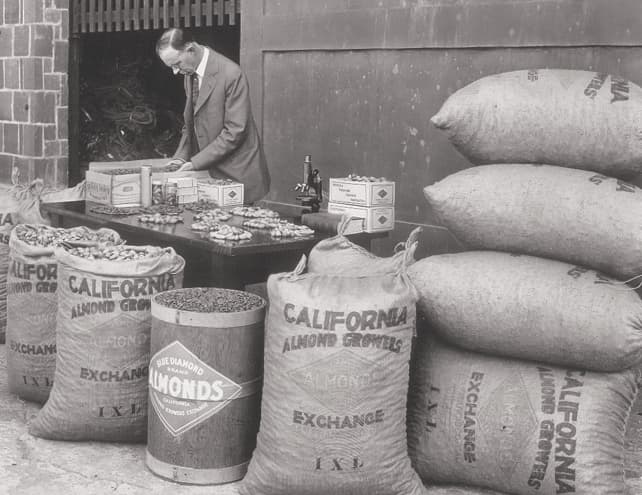
Throughout the early evolving years between 1910 and 1915, the Exchange worked to establish itself as a leading force within the global almond industry, but issues from broker incompetence to independent growers destabilizing prices continued to work against them. At that time, California only had about 20 percent or less of the world supply of almonds, while Spain and Italy grew the lion's share of at least 80 percent. It became quickly apparent to the members of the cooperative that a change in selling strategy was needed and that a name that translated into a high quality image for consumers was the answer. But what label could they attach to their boxes and burlap bags of California almonds that would differentiate them from imported almonds and leave consumers with a lasting high quality image of California almonds?
|
1915: In their minds, it was clear that the Blue Diamond brand also provided U.S. consumers with a consistent way to recognize new California almond products as they developed throughout the century. When the newly formed brand was named a Grand Prize Winner at the Panama Pacific International Exposition in San Francisco, California in 1915, the Exchange's efforts to establish the Blue Diamond Brand as a leader in the almond industry clearly launched the beginning of 100 years of new almond products in all shapes and sizes for consumers worldwide! In 1915, the label itself simply said Fancy Almonds Brand inside a blue diamond-shaped logo. It was during the Panama Exposition that this label was placed on burlap bags, boxes and clear glass jars and that a young girl of about 8 years old began posing for displays and promotional materials for the Exchange. Her name was Thelma Tucker, the young daughter of the first General Manager of the Exchange, T.C. Tucker, who was hired to oversee the marketing and sales of the Exchange from its original office in San Francisco, California in the famous Dollar Building owned and operated by the Dollar Shipping Lines. Photo caption: 1915 logo for Fancy Brand Almonds of California Almond Growers Exchange. |
|
1917: Photo caption: The 1917 Blue Diamond Logo. |
![]() |
1920s: By 1927, references to the California Almond Growers Exchange were dropped and the Blue Diamond Brand Almond label continued to dominate in the late 1920s and 1930s. The shape, color and depiction of the brand name varied during this time without any clear standardization. Photo caption: Blue Diamond's logo during the 1920s. |
![]() |
1937: Photo caption: One of the logos used by Blue Diamond in 1937. |
|
1946: On top of the already devastated prices for almonds seen around the world, California had prospects for another huge crop. Hoping to access a greater number of markets, the California Almond Growers Exchange applied for export subsidies from the United States Secretary of Agriculture, Henry Wallace. The timing seemed perfect. Foreign almond crops were having issues overcoming trade barriers, and California was seeing yet another year of inventory surplus. With the new aid in accessing foreign markets, the time had come to redesign the cooperative logo. Big and bold, the new Blue Diamond Almonds logo brought attention in grocery stores and other markets to new products, and old favorites, with its bright lettering and deep blue background. The word Brand was dropped from the logo at this time. Photo caption: A Blue Diamond logo used in 1946. |
![]() |
1950: With business booming, the time came for a new logo to represent the taste and preferences of the time. Sleek, yet subtle, the new diamond-shaped logo emphasized the product it embodied in a dark navy blue color that re-incorporated the word brand in the logo, only to be dropped yet again in 1953. This time the logo was back to a brighter blue with an emphasis on bolder lettering for the word almonds! Photo caption: A Blue Diamond logo used in 1950. |
|
1967: Having been selected from hundreds of other design proposals, this new mark incorporated both the diamond shape and the profile of an almond, giving it a rounded look with matching the logo itself. As it was described then, "The new lettering, also custom designed, carried not only an attractive, unique look, but also the subtle addition of an almond shape into the "O" in Diamond." It was simply Blue Diamond now, a name that had become readily recognized by American consumers. It also began appearing on branded Blue Diamond products developed especially for Japan and distributed by the independent Coca Cola Bottlers. After 60 years of evolution, the cooperative brand was finally standardized for all industrial and consumer products. Because of the tremendous success of the design, it continued to be the recognized symbol for the next 28 years of Blue Diamond Growers' history. Photo caption: The Blue Diamond logo standardized in 1967. |
1988: Many dramatic changes had taken place since 1910, causing the company to take yet another serious look at its name. At this time, the California Almond Growers Exchange had grown from a cooperative of 230 almond growers to nearly 5,000 growers who now owned the world's largest almond processing and marketing organization. Over 70 percent of the world's almonds now grew in California, displacing Spain and Italy as the major producers. And 70 percent of California almonds were exported to over 90 countries, ranking them as the top food export in the state! Blue Diamond Growers ranked as a Fortune 500 company, generated revenue of nearly $500 million dollars, topped number 57 on the 100 food companies list and sold over 2,000 products in 90 different companies! Blue Diamond had emerged into a progressive company that accepted change as a requirement for success. A decision was made by the nine board members (all of them almond growers) to conduct business as solely Blue Diamond Growers. By changing the name of the cooperative, all logos officially dropped any reference to the California Almond Growers Exchange in 1988, except for the historical designs embedded on its buildings at its headquarters in Sacramento, California. The brand was now the recognized symbol for what its pioneering growers imagined — the highest quality almonds in the world! A dream was realized! Photo caption: |
|
![]() |
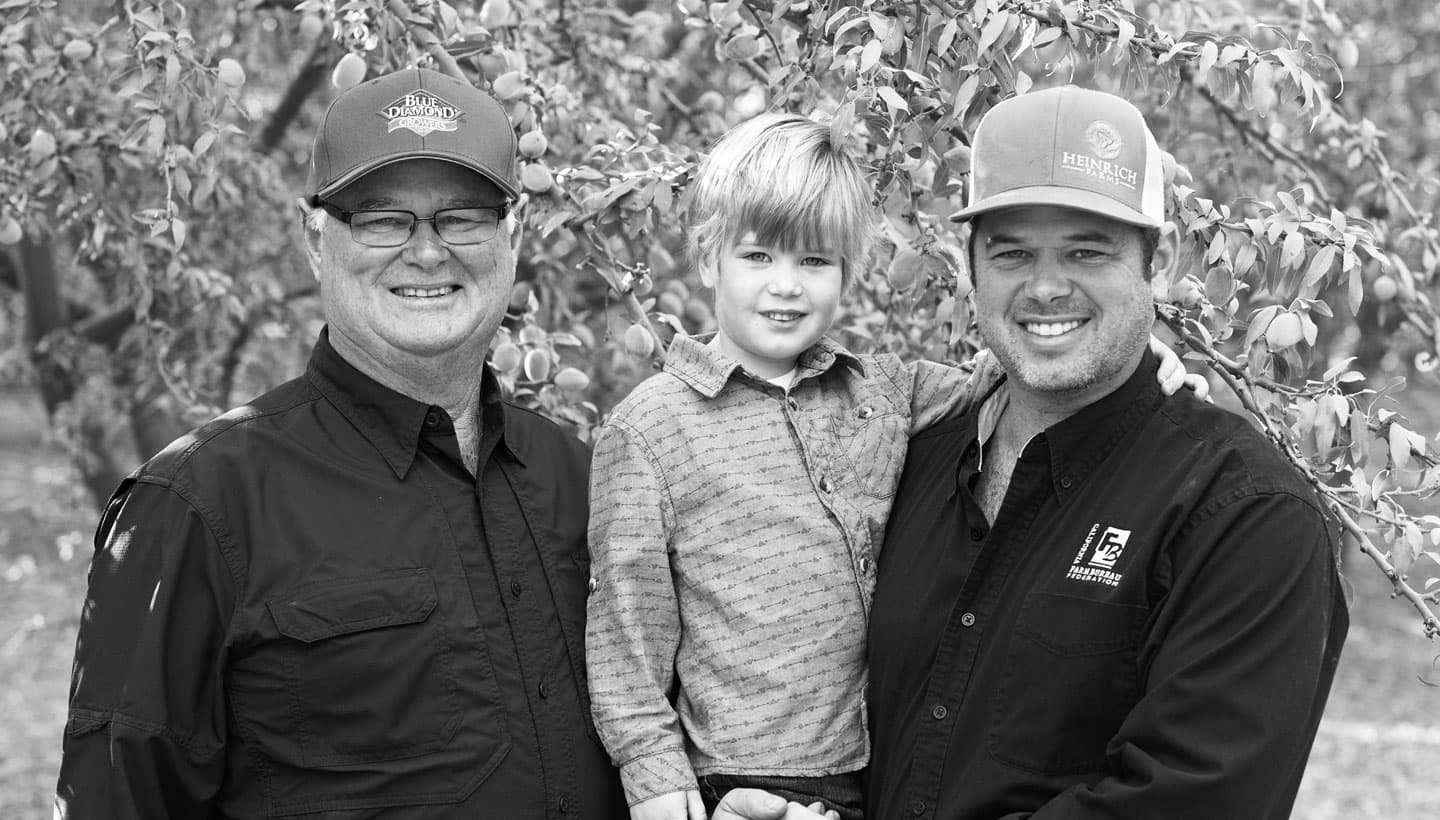
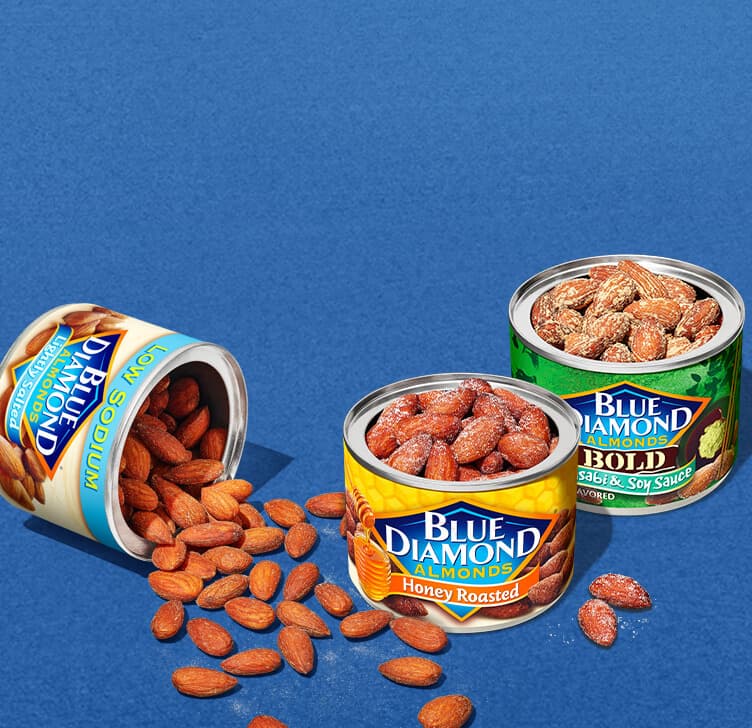
1990s: As a grower-owned cooperative, Blue Diamond wanted to emphasize the direct connection between its growers and those consumers who preferred naturally grown almonds straight from the orchard. The popular television campaign that had already emerged in 1986, A Can A Week, That's All We Ask, featuring Blue Diamond growers buried in plentiful supplies of almonds, finally linked the actual producers to the consumer. Today, consumers can still recall the slogan and the real growers asking them to buy more almonds. At one time, it ranked among the top 10 slogans in America! To illustrate the link between cooperative growers and their brand, cans and packages of Blue Diamond Whole Natural Almonds, a new aseptically packaged Almond Breeze non-dairy beverage (developed in 1998) followed by an assortment of Nut Thins Crackers all bore the additional words of Growers Co-op on the Blue Diamond label. Today Blue Diamond's Natural Foods products are the fastest growing segment of its branded business. Photo caption: The Blue Diamond Growers Cooperative logo established in the 1990s. |
|
2005: Photo caption: The Blue Diamond brand logo established in 2005. |
|
2006: Photo caption: The Blue Diamond Growers cooperative logo: "Power in Partnership" established in 2006. |
![]() |
2010 Photo caption: Blue Diamond Growers 100th anniversary centennial logo of 2010. |