Blue Diamond Growers Almond Market Report – September 11, 2026
Market Summary
Demand Drivers
- Global shipments have exceeded prior year in six of the past seven months.
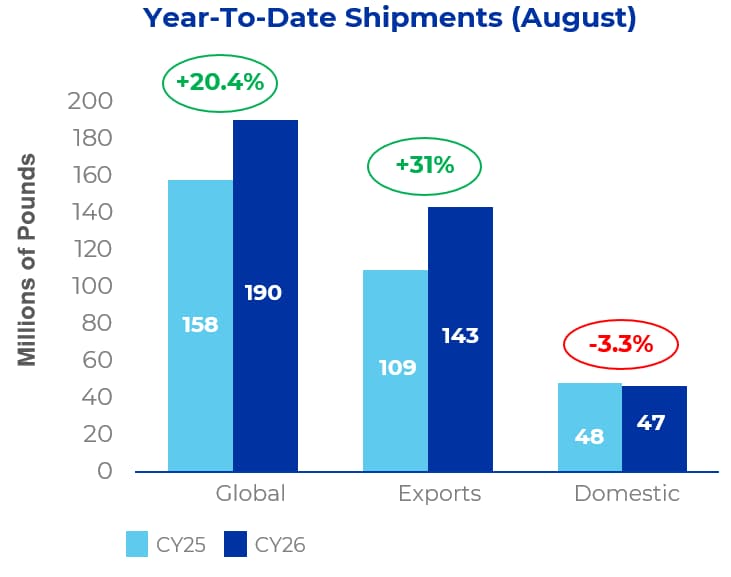
- Exports experienced a strong start to the year (+31% YOY).
- India demand surged ahead of festival season (+170%).
- Europe remained strong despite higher prices (+6%).
Demand Constraints
- Higher prices are creating buyer resistance, with some markets reducing purchase quantities or shortening coverage.
- Domestic shipments remain soft with signs of stabilization (-3.3%).
- China/Hong Kong direct shipments declined amid continued trade uncertainty (-52%).
Supply Drivers
- Harvest began two weeks early and accelerated new crop receipts for August (+55%). The increase is not a reflection of crop projection.
- Early Nonpareil quality is strong with low reject levels.
Supply Constraints
- Tighter transition between crop years due to decreased carry-in position by 2.7%.
- Yields in Nonpareil and Independence receipts are signaling a lower 2026 crop than 2025, as forecasted.
- Larger kernel sizes are increasingly limited and creating a wider gap in premiums between sizes.
Looking Ahead
Fundamentally, the industry enters the new crop year from a solid position. The 470.7-million-pound carry-in (of which only 447.1 million pounds is estimated as edible) is down from prior year and confirms the tightness in supply from one crop to the next. Downward pressure on crop potential and overall supply and demand fundamentals continue to support a stable-to-firm market outlook. Export demand remains healthy with the coming weeks expected to provide clarity on crop size, kernel sizing, and the degree to which rapidly appreciated pricing can be absorbed by end markets.
Shipment Summary
The 2026 crop year started on a positive note, meeting strong industry expectations. August shipments totaled 190 million pounds. Exports reached 143.2 million pounds, an increase of 31%, while the domestic market shipped 46.8 million pounds at a modest -3.3% decrease versus last year. With six of the last seven months’ total shipments outpacing previous year, the industry continues to experience strength in global demand.
Regional Dynamics
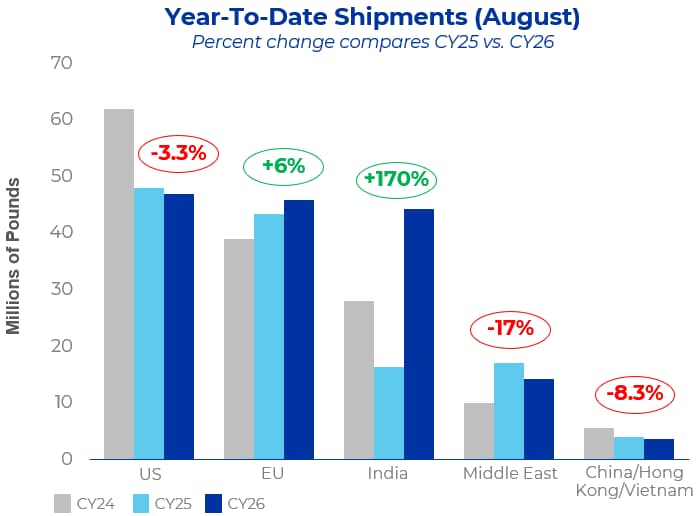
India: India was the clear standout in August, receiving 44.3 million pounds, up approximately 170% from 16.4 million pounds last year. The increase reflects stronger replenishment ahead of the festival season and a normalization from the unusually low August 2025 shipment level. The magnitude of the increase is notable given elevated pricing and confirms India’s continued importance as the primary outlet for California inshell almonds. Local consumption will become increasingly important ahead of festival season as buyers will begin to replenish stocks that dwindled at the end of the 2025 crop year.
China/Hong Kong/SE Asia: August shipment data highlights an ongoing shift in Asian trade flows. Vietnam posted a 10% increase versus last year, while Thailand (+84%) and Malaysia (+53%) recorded significant gains, reflecting their growing roles as processing and transshipment hubs serving Chinese demand. Direct shipments to China/Hong Kong, however, declined 52% year over year. Looking ahead, optimism remains that the September 24th meeting between President Trump and President Xi could lead to progress on trade and tariff issues, potentially paving the way for increased direct shipments into mainland China ahead of Chinese New Year.
Europe: Europe posted another constructive month, with total shipments reaching 45.8 million pounds, up approximately 6% year over year. Western Europe increased 8%, led by Italy, Germany, and the United Kingdom. Despite elevated pricing, European buyers continue to seek coverage, although purchasing remains disciplined and increasingly focused on shorter shipment windows.
Middle East: Middle East shipments totaled 14.2 million pounds, down 17% from last year. Performance varied considerably by destination. Turkey increased 113% to 7.0 million pounds, while the UAE declined 63% to 4.3 million pounds and Saudi Arabia declined 54%. The shifting regional mix, as highlighted by a 265% increase into Pakistan, continues to reflect changing trade routes, inventory positions and geopolitical/logistical disruption rather than a uniform change in underlying consumption and overall demand levels.
Domestic: August domestic shipments totaled 46.8 million pounds, down 3.3% year over year. While this may not have been the start to the year the industry had hoped for, the improvement in shipment performance over the last six months provides optimism that the market has stabilized. As prices rose over the last month, purchasing activity slowed and shifted to closer, strategic locations. This cautious approach is expected to continue. Looking ahead, domestic demand is expected to remain steady, with a pipeline of commitments providing support for shipments in the next few months.
Commitments
Cautious buying and selling due to crop size uncertainty, paired with an increase of 33 million pounds in shipments for August has commitments down 5.5% for the first report of the season. The early crop and faster receiving pace has resulted in uncommitted inventory being up by 124 million pounds at 176 million pounds for now. We anticipate this to balance out over the coming months. The table below shows commitments and sales in both domestic and export markets.
| Region | Commitments YTD | vs. PY | August 2026 Sales | August 2025 Sales |
| Global | 497.4 | -5.5% | 138.8 | 184.2 |
| Domestic | 155.1 | -9.2% | 16.5 | 54.9 |
| Exports | 342.4 | -3.8% | 122.3 | 129.3 |
Volume reported in millions of pounds
Crop
The 2026 crop is progressing rapidly with current receipts for August coming in at 401.9 million pounds. The pacing of receipts is 55% above August 2025 due to harvest beginning approximately 2 weeks earlier than prior year. The increase in receipts over last year is not a reflection of projected crop receipts for 2026.
Nonpareil and Independence varieties are largely harvested with pollinizer varieties following closely behind. In some of the most advanced areas, growers have completed orchard harvest activities and are focusing on post-harvest practices and minimizing water stress to support next season’s crop.
Current Nonpareil reject levels are the lowest in several years, though ticking up slightly, driven by a third flight of navel orangeworm. Independence rejects are trending higher than last year, mainly due to brown spot from leaf-footed plant bugs. Yields are variable in Nonpareil and Independence depending on the region. Speculation on smaller kernel sizes coming into harvest are beginning to be realized. Yields in Nonpareil and Independence receipts are signaling a lower 2026 crop than 2025, as forecasted. There is continued downward pressure on crop potential, which will be informed by pollinizer varieties that hullers are beginning to process. Next month’s report may reflect further shifts to the forecast as pollinizer volume comes in and is accounted for.