Blue Diamond Growers Almond Market Report – August 12, 2026
OVERVIEW
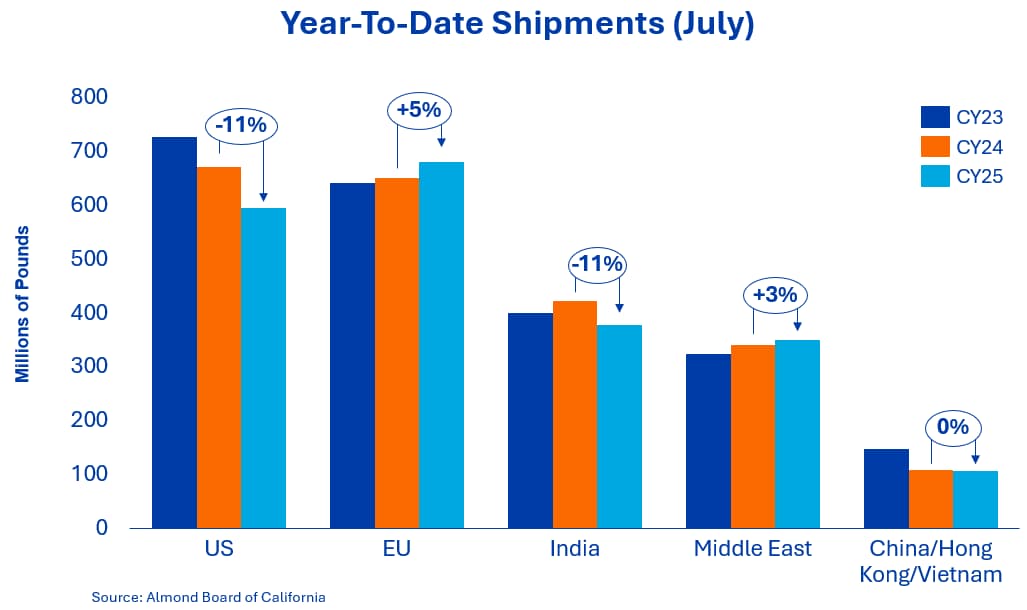
The Almond Board of California released the final Position Report for the season, which represented a strong finish for the industry. July shipments totaled 203.5 million pounds, slightly above industry expectations at a 3.3% increase versus prior year. Exports reached 150.3 million pounds for the month, up 2.3% from prior year. Exports continue to be growth markets for the almond industry, closing the season at a 3% increase versus prior year, with total shipments at 2.03 billion pounds. Domestic shipments for July saw an exciting increase of 6.2% compared to the previous year. Domestic year-to-date shipments now total 595.3 million pounds, down 11.3% for the season. Total industry shipments through July have now concluded at 2.63 billion pounds, a decrease of 0.64%.
SHIPMENTS
India: India shipped 34.3 million pounds in July, down approximately 25% versus last year, and finished the crop year at an 11% decrease of 378.5 million pounds. The decline primarily remains related to inshell, with crop year 2025 availability constrained following reduced inshell production earlier in the season.
Despite the year-over-year shipment decline, underlying consumption remains constructive as it heads into the festival season. Local inventories remain relatively lean, while early new-crop sizing concerns have increased urgency around larger Nonpareil and Independence inshell. Buyers remain highly price-sensitive and tactical, but with Diwali demand approaching and replacement supply still uncertain, India should remain an important source of demand during the opening months of the new crop year.
China/Hong Kong/SE Asia: China/Hong Kong’s July shipments totaled just under 1.0 million pounds, with year-to-date volumes finishing 34% behind last year at 33.3 million pounds. With ongoing concerns over quality of the Australian crop (color and roastability), California could be positioned to regain share heading into crop year 2026.
July shipments to Vietnam totaled 2.69 million pounds. Despite the July slowdown, Vietnam remains the growth driver in the region, having imported 74.6 million pounds for the season and finishing with a standout increase of 30% on the year. In total, Southeast Asia was a strong destination for California almonds, finishing up 26% on the year.
Europe: European shipments totaled 51.7 million pounds in July, approximately 7% below last year, while full-year shipments reached 681.2 million pounds, nearly 5% up. Western Europe finished approximately 3% ahead, while Central and Eastern Europe increased 31% year over year.
Spain was one of the year’s strongest major markets, finishing at 199.3 million pounds, up 19%, while Italy increased 9%. Germany finished approximately 5% below prior year and the Netherlands declined 23%. Belgium also posted substantial growth, increasing 69% for the crop year.
Near-term activity remains seasonally subdued during Europe’s summer holiday period, but many buyers entered summer with limited Q4 coverage. We expect purchase activity to increase as processors return and begin securing requirements for fall and holiday production.
Middle East: In July, the Middle East received 20.1 million pounds versus 14.4 million last year, an increase of approximately 39%. Full-year shipments reached 351.3 million pounds, 3% ahead of the prior year despite regional geopolitics. This highlights the resilience in demand from the region.
With the UAE down 24% on the year, Turkey remains the standout, shipping 10.8 million pounds during July (more than double last year) and finishing the crop year at 156.6 million pounds, up 45%. Turkey has become an increasingly important kernel market and remains an attractive growth region for California almonds. Buyers will be looking to source early new crop shipment windows in preparation for the Ramadan holiday.
Domestic: The domestic market finished the crop year 11.3% behind last year following a strong finish to the season. July domestic shipments totaled 53.2 million pounds, marking the largest monthly shipment volume of the crop year and capping a five-month stretch in which shipments were down just 0.4% year over year. This is a significant improvement from the 18% decline recorded during the first seven months.
While domestic demand remained below prior-year levels, the significant improvement in shipment performance throughout the second half of the crop year suggests the market has stabilized. Purchasing activity gradually shifted toward securing new crop coverage as current crop availability tightened and confidence in the new crop grew. Looking ahead, domestic demand is expected to remain steady, with a healthy pipeline of commitments providing support for shipments in the early months of the new crop year. Overall, continuously improving demand trends, balanced supply fundamentals, and disciplined buying behavior should provide a stable foundation for the market.
COMMITMENTS
Total commitments continue to be strong at 246.2 million pounds, pacing ahead of last year by 14.3%. New monthly sales for the current crop were 81.3 million pounds. The domestic market secured 16.6 million pounds, while exports added 64.7 million pounds of new coverage. Total current crop commitments for the domestic market are now at 108 million pounds while exports have reached 138 million pounds. Uncommitted inventory is now down 17.18% at 248 million pounds versus 299 million pounds prior year.
New crop sales were reported at 155 million pounds. The domestic market’s new crop commitments now stand at 77 million pounds, while export commitments have reached 225.5 million pounds, bringing total new crop commitments up to 302.5 million pounds.
CROP
The 2026 harvest is in its early days, with receipts just beginning to come in. Northern and Southern growing regions began harvest at the end of July, and the Central region is ramping up this week.
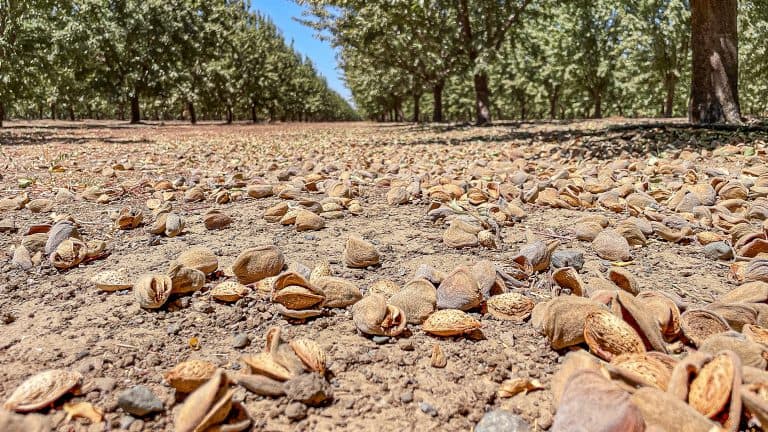
In the orchard, harvest timing between different varieties appears to be compressed compared to previous years. With multiple varieties ready to harvest, growers are making decisions on how to sequence and manage irrigation and navel orangeworm (NOW) controls. Early observations on quality are better than last year in early harvested varieties, but because of compressed variety timing, we’ll be tracking quality as the season progresses.
Huller-shellers are running faster than last season, and the overall crop continues to track roughly two weeks ahead of the 2025 crop. Hot and dry conditions have accelerated harvest timing by drying the crop more quickly, ultimately pushing nuts through the huller-shelling process faster than normal.
Early observations point to kernel sizes running smaller so far this season. This is an early read, and receipts from the Central region are needed to form a complete statewide picture on sizing. Over the next few weeks, crop comparisons will begin shaping sentiment around turnouts, crop quality and size.
MARKET PERSPECTIVE
The 2025 crop year ultimately demonstrated considerable resilience across the global landscape. Despite domestic shipments declining by double digits and buyers remaining highly price-conscious throughout the year, exports reached record levels and total shipments nearly matched prior year. More importantly, the industry is entering crop year 2026 with less than 500 million pounds of carryout, substantially higher commitments, and 17% less uncommitted inventory than one year ago.
The opening weeks of harvest have added another layer of support. Early reports indicate smaller-than-normal kernels, while final crop volume and turnout remain uncertain. These observations remain preliminary, but they have encouraged sellers to maintain disciplined offers while buyers evaluate replacement requirements. Many markets remain relatively lightly covered for calendar Q4, current crop availability is limited, and growers have little incentive to aggressively market new crop before better understanding their production.
As harvest progresses, greater physical availability should improve liquidity, but the industry’s starting position remains fundamentally healthy. Pricing is expected to remain supported as the market balances new crop receipts against uncovered global demand. Buyers should continue to evaluate coverage proactively, particularly for larger sizes and premium specifications where availability may remain more constrained.
The 2025 crop year finished on a strong note, and we enter the 2026 harvest with healthy fundamentals, manageable inventories, and encouraging demand prospects.